Filter by:
Clear All
Yad Vashem Publications




![תמונה של Yad Vashem Studies: Volume 51 [2]](https://store.yadvashem.org/images/thumbs/0002411_yad-vashem-studies-volume-51-2_415.png "Yad Vashem Studies: Volume 51 [2]")
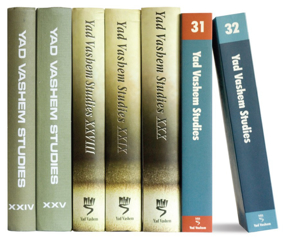
Yad Vashem Studies: Volume 51 [2]
Editor: Dr. Sharon Kangisser Cohen
Table of Contents:
Introduction • Susanne Heim and Ulrich Herbert - A Comprehensive Documentation of the Holocaust: The Completion of the VEJ Project • Eliyahu Klein - Between Rescue and Persecution: Defining and Mapping the Range of Behaviors Toward Oppressed Jews During the Holocaust in the Countryside of Occupied Poland • Attila Gidó - Survivors of the Northern Transylvanian Deportations: Liberation, Repatriation, Reckoning • Gali Drucker Bar-Am - “Record and Lament”: Yizkor Books as History and Literature Conflated • Merav Yisrael and Gila Prebor - The Yizkor Book Collection in the Yad Vashem Library in Jerusalem: A Bibliographical Analysis
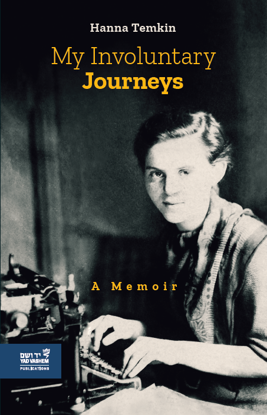
My Involuntary Journeys
Hanna Temkin
In My Involuntary Journeys, Hanna Temkin shares her story for the first time, shedding light on lesser-known aspects of Jewish life and survival in Eastern Europe before, during, and after the Holocaust. Moreover, Hanna’s story is an inspiring tale of female empowerment and serves as a testament to her ability to overcome the worst odds.
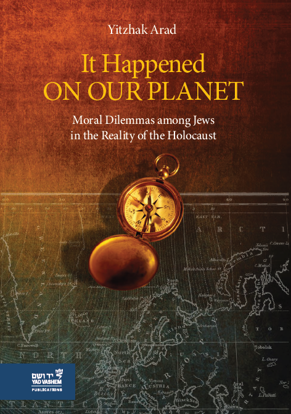
It Happened ON OUR PLANET
Moral Dilemmas among Jews in the Reality of the Holocaust
By Yitzhak Arad
It Happened on Our Planet offers a brutally honest insight into the horrifying decisions that the Jews had to make and the unbearable situations in which the Jews found themselves during this time. The publication of this important work presents generations to come with a better understanding of the complex reality of the Holocaust.
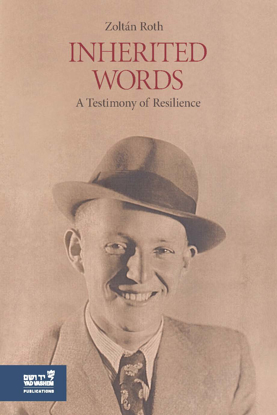
Inherited Words: A Testimony of Resilience
Zoltán Roth
There were many times when I felt an irresistible desire to stop, and those were moments that I had to really choose between fighting for life or not. My other option was to continue walking. It seems that struggling for the yet unlived part of my life was stronger. I didn’t stop.
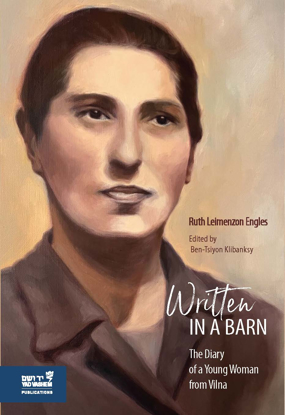
Written in a Barn: The Diary of a Young Woman from Vilna
Ruth Leimenzon Engles| Edited by Ben-Tsiyon Klibansky
At last, I have gotten a notebook in which to write. I have a pencil. I will try. Maybe it will make it easier to push through the days. It’s hard for me. As soon as dawn breaks, my first thought is: how does one endure until the end of the day.
Ruth Leimenzon Engles, May 15, 1944
A few days after the Germans occupied Vilna at the end of June 1941, Ruth Leimenzon’s husband was seized by local collaborators and was never seen again. Ruth, the sole survivor of her murdered family, managed to survive two years in the ghetto using her intelligence and common sense, helped by luck and perhaps miracles. Just two days before the ghetto’s liquidation in September 1943, Ruth escaped with the help of a Christian woman, her former boss’ wife, and found a hiding place in a barn on a farm 20 kilometers from Vilna, where she hid for nearly a year. During the last two months in the barn, Ruth wrote a diary in Yiddish describing her three-year ordeal.
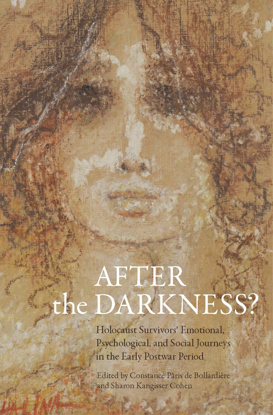
After the Darkness?
Holocaust Survivors’ Emotional, Psychological, and Social Journeys in the Early Postwar Period
Editors: Constance Pâris de Bollardière and Sharon Kangisser Cohen
His reaction to my cautious questions about his parents, his brothers and sisters, his experiences in the concentration camp was characteristic. His only response was to let his head drop onto his chest. He remained sitting in this posture in silence for some time. It must be said here without pathos or literary embellishment that it is only now that he has been returned to normal life that this child feels the pain and torment of everything he has seen and experienced.
Hans Keilson
![תמונה של Yad Vashem Studies: Volume 51 [1]](https://store.yadvashem.org/images/thumbs/0002275_yad-vashem-studies-volume-51-1_415.jpeg "Yad Vashem Studies: Volume 51 [1]")
Yad Vashem Studies: Volume 51 [1]
Edited by Sharon Kangisser Cohen
Table of Contents: • Introduction • Michael Robert Marrus (1941-2022)—In Memoriam (Doris Bergen) • The Polish Underground State and the Financing of Help for the Jews: An Attempt at a New Approach (Dariusz Libionka) • News from Auschwitz: The International Underground’s Secret Reports and the Jewish Holocaust (Tom Navon) • Bandera, Genocide, and Justice: Was Stepan Bandera Responsible for Crimes Committed by the OUN and the UPA? (Grzegorz Rossoliński-Liebe) • Politics of Holocaust Memory in Communist and Post-Communist Romania: On Survivor Matei Gall’s Multiple Life Stories (Ștefan Cristian Ionescu and Dana Mihăilescu)
Entanglements of War: Social Networks during the Holocaust
Edited by: Eliyana R. Adler and Natalia Aleksiun
The Nazi persecution and murder of the Jews of Europe led to the atomization of the social relationships of the victims. Families were ripped apart. Entire communities were ghettoized and isolated from the outside world. The forced removal of the Jews from the midst of the non-Jewish population facilitated the crimes committed against them, significantly limited the assistance they could rely on, and restricted the number of witnesses to their persecution and murder. However, despite the devastation, disruption, and loss brought by the Holocaust, prewar patterns and lationships continued to shape decisions and actions by Jews and non-Jews both during and after the war. Even in extremis, they often relied on established networks of support that had been forged in very different circumstances. Jewish victims as well as bystanders and perpetrators relied on the already familiar cohort of relatives, neighbors, peers, and colleagues to support and assist them during this time. Just as these networks brought people with various backgrounds together, Entanglements of War compiles a broad range of interdisciplinary perspectives to reveal invaluable findings about the relationships, choices, and actions that shaped these complex connections, and their impact on Jewish lives during the Holocaust and its immediate aftermath.
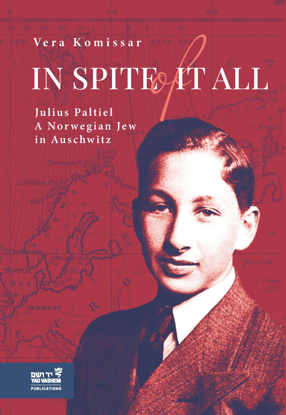
IN SPITE OF IT ALL: Julius Paltiel - A Norwegian Jew in Auschwitz
Vera Komissar
A child’s cry pierces the stillness. The wail breaks the dismal silence that fell when the doors were locked. It’s as if the child’s tears give us all permission to let out our despair. Julius Paltiel grew up in Trondheim, Norway, where he lived with his mother and his brother. Like all the Jews of Norway, their lives changed forever when the Nazis came to power in April 1940. His arrest at the age of eighteen in 1942 marked the beginning of a journey of inconceivable horror and brutality in the Nazi concentration camps. Initially incarcerated in Falstad, a Nazi concentration camp in his native Norway, Julius Paltiel was then deported to Germany by sea in February 1943 before boarding a train to Auschwitz. He was selected for forced labor to work for IG Farben in Auschwitz III–Monowitz. In January 1945, he was sent on a death march to Buchenwald where he was liberated by U.S. forces on April 11, 1945. Julius Paltiel is one of the few Norwegian Jews who survived and returned from Auschwitz and one of the Jewish survivors who testified in the war crime trials against the Nazi perpetrators in Norway. He dedicated his life to the fight against antisemitism to ensure that such horrors would never happen again. As one of only a handful of Holocaust testimonies from Norway, In Spite of It All sheds light on Julius Paltiel’s personal ordeal to survive the Holocaust as well as on the Jewish persecution and murder of Norway’s Jewish community. This tale of survival also serves as a warning of the atrocities that are possible at the hands of ordinary human beings.
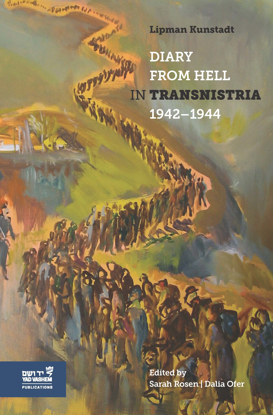
Diary From Hell in Transnistria 1942–1944
Lipman Kunstadt | Edited by Sarah Rosen and Dalia Ofer
I decided to stop writing the diary and to destroy the pages… I eventually overcame the despair and listened to the counterargument…a miracle may occur and your fragmentary writings will be the only remaining memory of Transnistria. (Lipman Kunstadt, August 26, 1942)
Diary from Hell in Transnistria is a painfully vivid and intricate account of life in the Dzhurin ghetto in Transnistria, written by Lipman Kunstadt, who was deported there from Radauţi, Romania, with his wife, his children, his mother, and his sister on October 14, 1941. Kunstadt, who was well-educated and a journalist, was appointed secretary of the Jewish council in the Dzhurin ghetto, where he had access to a great deal of information about its inner workings. He began writing his diary in Yiddish on April 11, 1942, at great risk, sparing no criticism against the ghetto leadership.
The Holocaust in Hungary, 4: "Possibilities and Limits of Testimonies": The Pusztavám Massacre - Jewish Survivors as Witnesses
Anikó Boros
Translated from the German by Christopher Reid